Dalrymple's Disappointment
A Review of The Golden Road: How Ancient India Transformed the World

I always relish a new release from William Dalrymple. I have read most of his books. City of Djinns was the enzyme I needed to digest New Delhi on my first set of visits there in the 1990s. My initial impression of the city was one of grubby chaos with little to redeem it other than its strangeness. But City of Djinns peels back the grime and through a personal account paired with compelling history, the city became something to explore, to appreciate, to see with new eyes. And most of Dalrymple’s books do the same.
Dalrymple is a popularizer, and I mean this in the best sense. He digs deep into the literature of a subject and is a masterful storyteller. He does this successfully again and again in his books.
The Anarchy: The Relentless Rise of the East India Company is a superb history, a complete accounting of the East India Company and the colonial legacy of Britain. It is a clear-eyed account that is a heavy condemnation against colonialism yet does not do it with the insipid postmodern decolonization frame that mars so much in the contemporary discourse on empire.
His From from the Holy Mountain is an incredibly important book, especially now that many of the Christian communities he depicts are gone or holding even more tenuously on to existence in unimaginably hostile environments across the Middle East.
White Mughals, Return of a King and The Last Mughal also are superb and entertaining histories, bringing the incredible time, characters, and culture alive for readers.
So it was with pleasurable anticipation that I cracked open his latest, The Golden Road: How Ancient India Transformed the World.

This book was released in the wake of an amazing amount of activity by Dalrymple. He is a major force behind what I consider the crown jewel (the Kohinor, the subject of another of his books) of literary festivals worldwide, the Jaipur Literature Festival. And how he has time to write a book while cohosting his Empire podcast, covering the history of the world is a demonstration of his hard work and focus if tendency to stretch himself a bit thin as he goes out on limbs that stretch far from the trunk of his main base of knowledge, India.
And sadly, that is what happens in The Golden Road. I have found that whenever Dalrymple turns his attention to Buddhism, despite his deep knowledge of so much of India’s past and traditions, it is always a bit off. His transgressions – whether errors of fact or where his own sensibilities obscure things - fall into a few categories: history and tradition, textual confusion, and an almost colonial, Christian-centric language which in other places in his writing would be a target of his criticism.
This latter category is on display throughout the book. I can imagine an author arguing that the usage of such terms is meant to help the reader bridge their world view with that of the subject. But that would be an odd case to make in a book about India’s chief export being that of ideas and beliefs. To give a few examples:
“Buddhist merchants were encouraged to look to their saviour for protection on the road or at sea” (page 48). Later (page 141), in describing the Chinese pilgrim translator Xuanzang’s translation efforts, he declares that the motivation was that Xuanzang though these texts “contained the key to salvation”.
While seeking refuge and protection from worldly threats is certainly part and parcel of Buddhism as practiced across traditions, this is an odd phrasing.
Another example is from his discussion on page 157 of Empress Wu Zetian where he says that she sponsored a sculpture to “expiate her sins”. This is again, a very Christian phrasing of a merit-making activity.
It is not just a Christian lens he brings to bear but also a very Indian one that in this book often comes across as very much an outsider’s view of Buddhism. A strong case can be made that Buddhism is another expression of a diverse but coherent Indian system, which is what Dalrymple is doing here. It is a fair argument to make and many have done it. The notion that the Buddha was an avatar of Vishnu is a classic example of India’s ability to syncretize and weave disparate things together. But there is also a strong case to be made – as some scholars and most Buddhist’s do – that Buddhism is in fact a significant departure. While maintaining continuity in many ways philosophical, soteriological, artistic, narrative, and otherwise, the Buddha’s teachings are fundamentally a rejection of much of what it came from.
And while either of these views could be an appropriate canvas to paint the story of Buddhism, in the company of Dalrymple’s other approaches to the subject outlined above and below, it reinforces the feeling of the whole project being a bit off. Some examples follow.
When discussing the glorious Ajanta cave paintings, he says the paintings are concerned with “justice, peace, and non-violence”. This imposition has echoes more of contemporary progressive mores rather than what the textual record reflects.
Earlier, Dalrymple states “Mahavira’s ideas initially appealed to Prince Siddhartha”. Jains were certainly in the mix, but all the recorded interactions of the Buddha and Jainism I am aware of are in the Pali canon where he debates and refutes. I am unaware of Sidhartha, pre-enlightenment, being aware Jain ideas let alone having them appeal to him.
On page 29, the author says the Buddha’s “message was instead based on love, kindness, compassion, detachment, non-violence, as well as intense meditation and personal self-discovery.” While this is not wrong, it is not how the texts, past or contemporary teacher, or most self-identifying Buddhists would put it. Love is more typically understood in the context of metta, but love and metta’s typical gloss, loving-kindness, have a slightly different sense. Non-violence is certainly present throughout the Buddhist tradition (and violence throughout its history!) but is usually expressed as not doing harm. But with Dalrymple, it feels like he is inserting Gandhi’s ahimsa in. Again, it is not wrong, just a little off. And “personal self-discovery” makes it sound like modern-day self-help more than any of the approaches from any Buddhist tradition.
He glosses (page 46) millennia of depictions of the Buddha as “lost in meditation”. As far as this reviewer is concerned, the Buddha was never lost. This is not the first time he has done this. In his review of the Metropolitan Museum of Art’s exhibition The Tree and the Serpent, he again says “It is very different from the pure and philosophically abstracted Buddhism admired around the world today, with its familiar image of the Buddha lost in meditation [emphasis added], hovering on the threshold of enlightenment”. It belies an outsider’s view, and a very critical one at that.
But then we arrive at some of the more factually challenged areas.
On page 91, he says that “Mahayanists believed in the great plurality of Buddhas”. It is true Mahayanists have a vast array of Buddha’s in their system, past, present, and future. But Dalrymple seems to believe that the Buddhism from the Pali canon only recognized Gautama Buddha, which is patently false.
When discussing Asanga and Vasubandhu, he says of them “both left home early to become philosopher monks in the fastness of the Karakoram mountains”. Peshawar in present-day Pakistan where they were born is hundreds of kilometers from the Karakorum mountains, so this is dramatic embellishment, not recorded history.
On page 113, he states that “in Zen art Bodhidharma is depicted as a large and powerful Indian fighting monk” and then goes on to make it sound like the great patriarch’s main claim to fame was his martial arts skills and connection to Shaolin. While there are depictions of him in this form, there are many others and his connection with Shaolin seems to be a 20th century invention. The excellent book Circle of the Way provides a good synopsis of Bodhidharma’s life.

The author he anachronistically refers to a prince in 148 CE as translating thirty “Theravada” texts. This is either an error or a simplification that plenty of others make. But the fact is “Theravada” as a tradition or a term is something that came to be in the 19th century.
It is Dalrymple’s obvious unfamiliarity with Buddhist texts that gets him into further trouble.
He refers to an “early Buddhist text called the Vinaya-Pitaka” (page 28). Calling the Vinaya Pitaka “a text” is a bit like calling Netflix “a show”. It is of course a set of multiple texts which totals thousands of pages.
He calls Asanga’s famed Abhisamayālaṃkāra “the Ornament of the Realisations”. While shining a light on a pluralization of a singular word (Realization) may be nitpicking, the meaning is important here. The Tibetan tradition talks about how advanced beings can understand a text just from the title. I wonder what would happen if they relied on Mr. Dalrymple!
Further revealing his unfamiliarity with the texts on the Prajñāpāramitā, on page 142 he says, “soon after completing work on the notoriously long and Complex Great Perfection of Wisdom Sutra…”. There are of course multiple Prajñāpāramitā sutras. Presumably, he is talking about the Shatasahasrika, but who knows. Not, apparently, Dalrymple, or he would have said so.
On page 92, he says Vasubandhu “compiled the equally revered Treasury of the Abhidharma, said to be the most subtle systemization of the Mahayana doctrine on the nature of Maya or Illusion”. I am not sure where he came up with this, given that it is not a text of the Mahayana. Rather it presents the views of the Vaibhashika, a school of the Shravakayana, closest to today’s Theravada among extant schools. Vasubandhu came to the view of the Mahayana after Asanga later taught it to him.
When discussing the galleries of Borobudur images on page 197 he says they show scenes “from a much less well-known Indian Buddhist text called the Gandavyuha.” Dalrymple clearly does not understand this is simply a section of the Avatamsaka or Flower Ornament Sutra he discusses on page 154. This sutra, far from being “less well-known” is one of the principal sutras in the Mahayana, with entire schools in China and Japan dedicated to it. It is one of the most oft-quoted sutras in the Tibetan tradition as well.
It is a shame that such a wonderful history is obscured by so many errors of fact, as well as a general sensibility and tone that do not reflect the tradition as it is perceived by either practitioners of Buddhism or scholars.
Despite all this there is still much that this book offers. Dalrymple’s sweeping look at Buddhism’s influence is inspired. His discussions of the Buddhist presence and art from the Western ghats and southern India is an area that deserves far more attention in the Buddhist world and made the book worth the price of admission. The spread of Indian ideas, art and architecture through southeast Asia is very well done.
I remain a fan of Dalrymple and will certainly read his future books, but I hope he either stays in his lane, digs much deeper into areas he is less familiar with before putting pen to paper, or gets subject matter experts to review his work. It could have saved him some embarrassment.
In the meantime, for people interested in Buddhism’s spread, here are some other suggestions:
A traditional account:

A scholarly take:

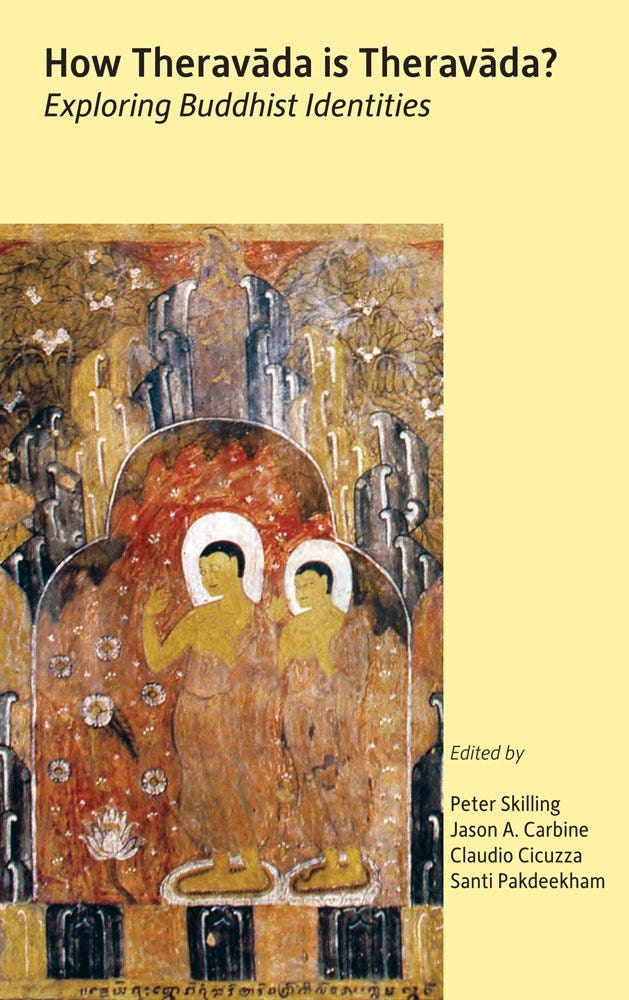
Sadly, this collection seems out of print but is worth seeking out: